
How to Get a Rental Approved With a New Puppy in Australia
Dog Ownership & Lifestyle By James C. • November 16, 2026
Renting with a dog in Australia starts with a written pet request, and in most states the landlord has 14 or 21 days to respond and can only refuse on set grounds. An early, complete request usually gets a yes before your puppy comes home.
The rules differ by state, so this article sets out each one, then shows you how to time the request, build a puppy pet resume and respond if the answer is no.
This is general information, not legal advice. Always check the current rules with your state tenancy authority before you act.
Can a Landlord Refuse a Dog in Australia?
A landlord can refuse a dog in Australia, but in every state and territory the refusal now has to fit rules set by tenancy law. Blanket “no pets” clauses no longer decide the matter on their own.
Most states list the specific grounds a landlord can rely on, such as unsuitable fencing, too many animals, likely damage costing more than the bond, or a strata by-law that genuinely prohibits pets. Saying “I prefer no pets” is not one of them.
Silence also matters. In most states, if the landlord does not reply in time, your request is treated as approved. In Victoria, the ACT, Tasmania and the Northern Territory, a landlord who wants to say no must go further and apply to the state tribunal.
What has not changed is that you must ask first. Bringing a puppy home without approval, outside the limited exceptions, can breach your lease and give the landlord grounds to act.
The practical takeaway for a puppy buyer is simple: submit your pet request before you commit to a breeder, and make it complete enough that the landlord has no reason to delay.

Renting With a Dog: Pet Request Rules by State
Every state requires a written request, and most give the landlord 14 days to respond, with New South Wales allowing 21. The table summarises the current rules as published by each state’s tenancy authority.
| State | How to ask | Response time | If no reply | Pet bond |
|---|---|---|---|---|
| NSW | Pet application form signed by all tenants | 21 days | Approved without conditions | Not allowed |
| VIC | Pet request form, one per pet | 14 days | Renter can keep the pet | Not allowed |
| QLD | RTA Form 21 | 14 days | Taken as approved | No extra bond or rent |
| WA | Form 25 Pet Request Form | 14 days | Tenant can keep the pet | Allowed, up to $350 |
| SA | CBS pet application form | 14 days | Taken as approved | Not allowed |
| ACT | Written request | Landlord must apply to ACAT within 14 days | Landlord taken to consent | Not allowed |
| TAS | Approved CBOS form | 14 days | Landlord taken to agree | Not allowed |
| NT | Written notice describing the pet | Landlord must object and apply to NTCAT within 14 days | Tenant may keep the pet | Not allowed |
Victoria
Victorian renters complete a separate pet request form for each animal. Under Consumer Affairs Victoria’s pet rules, the rental provider has 14 days to decide, must apply to VCAT to refuse, and cannot charge a pet bond. You cannot keep the pet while VCAT decides.
Queensland
Queensland tenants use Form 21, and the lessor must reply in writing within 14 days. The prescribed refusal grounds are set out in the RTA’s renting with pets fact sheet, and a reply stating only “no pets allowed” is not compliant.
New South Wales
Since 19 May 2025, NSW landlords have 21 days to respond or the pet is approved without conditions. Under the NSW Government’s pet rental rules, up to four animals is always reasonable, and higher rent or bond cannot be a condition.
Other States and Territories
In WA, landlords need Commissioner approval for most refusals, and the WA pet bond is capped at $350 for residential tenancies. South Australia bans separate pet bonds and limits refusals to listed grounds. In the ACT, a landlord can only refuse a pet with ACAT approval. Tasmania’s rules started on 20 March 2026, and Tasmanian landlords who refuse must apply to TASCAT. NT tenancies from 1 January 2021 follow a 14-day objection process through NTCAT.
When to Ask: Before You Pay a Puppy Deposit
Submit your pet request before you pay a breeder’s deposit, so the response deadline passes before your puppy’s collection date. This avoids losing a deposit or rushing to rehome a puppy.
- Read your lease and any strata or body corporate by-laws first.
- Choose the breed and expected adult size so the request is specific.
- Submit the correct state form or written request, keeping a dated copy.
- Wait for approval or for the response deadline to pass.
- Only then confirm the puppy with the breeder and set a collection date.
Many breeders let puppies go from eight weeks, so there is usually time to ask while the litter is young. Explain your timeline when you contact a breeder; it is one of the questions to ask before paying a deposit, and good breeders will understand. Keep the breeder updated if the landlord asks for more information.
NSW has one useful exception for new leases: applying within seven days of signing lets you keep the pet while you wait for a response. Elsewhere, assume you need approval before the puppy arrives.
How to Make Your Pet Request Hard to Refuse
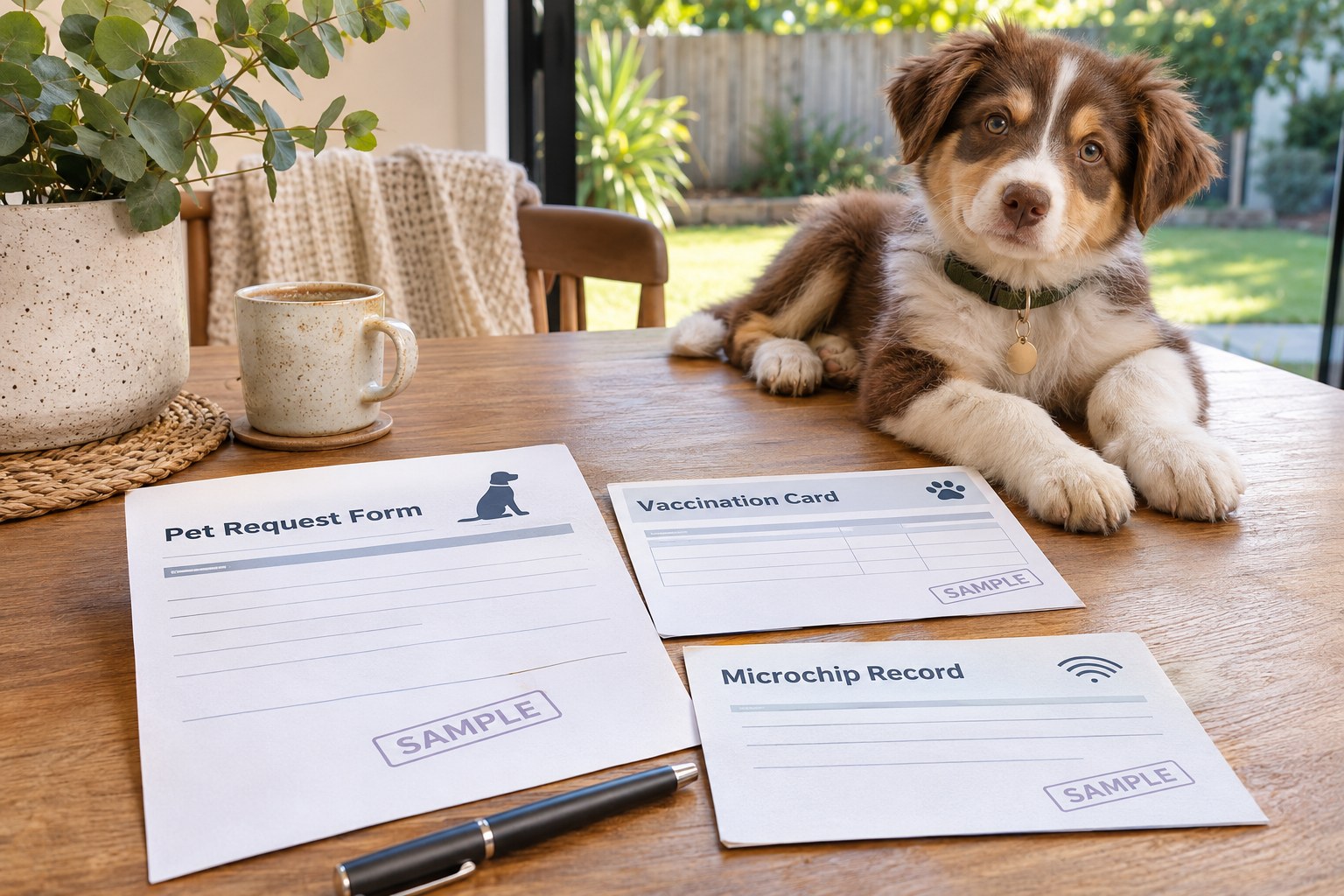
A complete pet request answers the landlord’s concerns before they are raised, which makes a valid refusal much harder. Focus on proof, plans and reasonable offers.
Build a Puppy Pet Resume
Include the breed, expected adult size, desexing plans and a photo. Attach the puppy vaccination schedule you will follow, proof of transferring the microchip into your name, a puppy school booking and any rental references.
Answer the Landlord’s Puppy Concerns
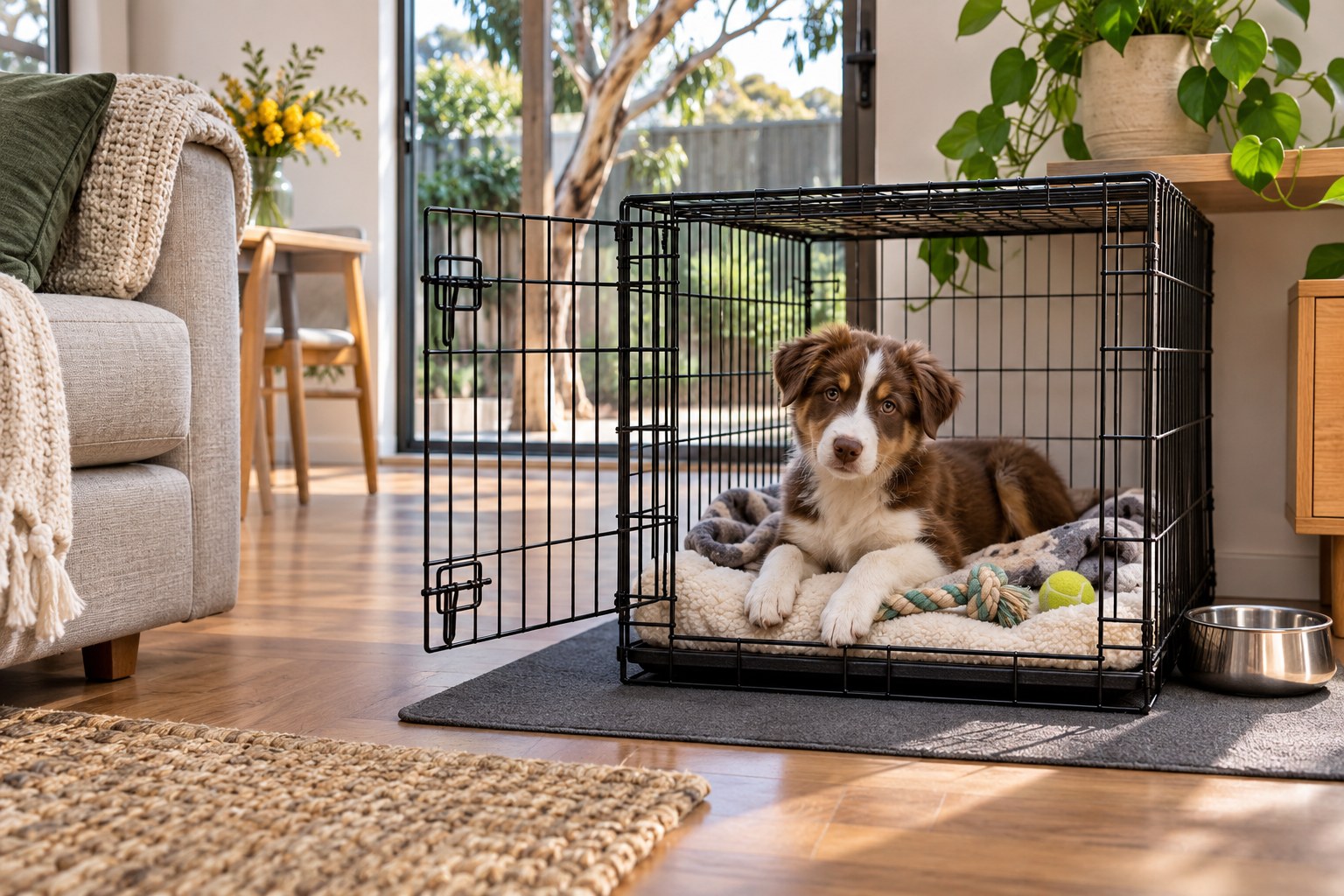
Landlords usually worry about chewing, toilet accidents and barking. Share a realistic puppy toilet training timeline, explain your crate and chew toy plan, and describe who will be home during the day. A crate also keeps the puppy safe and the property protected while you are out.
Offer Reasonable Conditions
Offering a professional carpet clean at the end of the lease, if the puppy lives indoors, reassures most landlords. Never agree to extra rent or a pet bond where your state bans them. Put any agreed conditions in writing, and offer to show the puppy’s setup at the first routine inspection.
Strata, Council and Assistance Animal Rules
Strata by-laws and council rules apply on top of landlord consent, so check them before you submit your request. A landlord’s yes does not override them.
In apartments and townhouses, the owners corporation or body corporate may need to approve a pet. In NSW, a strata by-law that bans all pets is not valid, but in WA a request is automatically refused where strata by-laws prohibit pets. Ask your agent for the by-laws, and any strata approval form, before you sign a lease.
Councils also set registration rules and limits on how many dogs you can keep, which vary by area. Check your council’s website for local limits, and register your puppy once it reaches the required age.
Assistance animals are treated differently. In most states, an accredited assistance dog is not counted as a pet and does not need landlord approval, although you should tell the landlord and they may ask for evidence of accreditation.
Before signing a lease, it also helps to puppy-proof a rental before your puppy arrives, protecting skirting boards, cords and flooring from day one.
What to Do If Your Pet Request Is Refused
If your request is refused, check the reason is a valid ground in your state, talk to the agent, then apply to the tribunal within its time limit. Many refusals are resolved with a conversation.
Start by comparing the stated reason with your state’s list of grounds. A refusal that simply says “no pets” may not be compliant in states such as Queensland and South Australia.
Next, ask the agent what would change the answer. Offering conditions such as a crate, outdoor toileting area or end-of-lease carpet clean can turn a no into a yes.
If that fails, take it to your state tribunal. In NSW, you must apply to NCAT within 28 days of receiving the landlord’s response. In Victoria, the ACT, Tasmania and the NT, the landlord must apply to the tribunal to refuse, so watch for that application and respond to it.
Keep every email and form. Also budget for the hidden costs of owning a dog, including end-of-lease cleaning or repairs, so you can show the landlord you are prepared.

Getting Your Rental Approved
Know your state’s rules, ask in writing early and keep a copy of everything.
A clear pet resume and a realistic training plan answer most landlord concerns before they arise.
Once approval is in hand, browse puppies for sale across Australia and plan your collection date with confidence.
Frequently Asked Questions
1. Can a landlord say no to a dog in Australia?
Yes, but only on grounds allowed by your state’s tenancy law, such as unsuitable fencing, too many animals or a valid strata by-law. In Victoria, the ACT, Tasmania and the Northern Territory, a landlord must apply to the tribunal to refuse a pet request.
2. How long does a landlord have to respond to a pet request?
In most states and territories, including Victoria, Queensland, Western Australia, South Australia, the ACT, Tasmania and the Northern Territory, the landlord has 14 days. In New South Wales, the landlord has 21 days, counting weekends and public holidays, from the day after receiving the application.
3. Can a landlord charge a pet bond?
Only in Western Australia, where a pet bond of up to $350 is allowed for residential tenancies. Other states and territories do not allow a separate pet bond, and landlords cannot use a higher general bond or rent increase as a condition of approving a pet.
4. What happens if my landlord does not reply to my pet request?
In most states, silence counts as approval once the deadline passes. In NSW, the pet is approved without conditions after 21 days. In Queensland, South Australia, Victoria, Western Australia, Tasmania, the ACT and the NT, you can generally keep the pet after 14 days.
5. Can I get a puppy in a strata apartment?
Often, yes, but strata or body corporate by-laws apply on top of landlord consent. In NSW, a by-law banning all pets is not valid, while in WA and the NT a strata prohibition can block a request. Ask for the by-laws before signing a lease.
6. Do I need permission for a puppy if my lease does not mention pets?
Yes. In every state you need the landlord’s consent, or the deemed approval that follows a missed deadline, before keeping a pet. A lease that is silent on pets does not count as permission, so submit your state’s pet request form first.
7. Can a landlord ask for extra rent if I have a dog?
No. Tenancy authorities in New South Wales, Queensland, South Australia and Tasmania confirm that higher rent or a larger bond cannot be a condition of approving a pet. Reasonable conditions, such as end-of-lease carpet cleaning, may still apply where relevant.
 Add us as a preferred source